
 What are the characteristics and usage precautions of gear couplings?-Company News-Speed Torque Transmission Technology Co-Deep plowing in the field of couplings, integrating R&D, production and sales
 English
 Chinese
 Russian
Characteristics and Usage and Maintenance Guidelines of Gear couplings Gear couplings are key devices in mechanical transmission systems that connect two shafts and transmit power and torque. Together with serpentine spring couplings and membrane couplings, they form the mainstream transmission solutions. It achieves power transmission through gear meshing and is widely used in industrial equipment. |
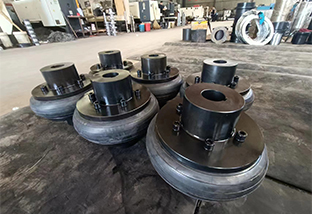 Figure: Schematic diagram of the gear meshing structure of a gear coupling |
I. Core Performance Characteristics |
High-efficiency and precise transmission
It adopts precise gear meshing transmission, with a transmission efficiency of over 98% and excellent transmission accuracy. It can stably transmit large torque and meet the power requirements of high-precision equipment.
Smooth torque transmission
The gear tooth surfaces have uniform contact, and there is no obvious shock during the power transmission process. This can effectively reduce the vibration of the transmission system and ensure the stability of equipment operation.
Compact and lightweight structure
Compact in design, it occupies a small installation space and is compatible with the transmission layout of various mechanical equipment, especially suitable for working conditions with limited space.
Extremely long service life
Made of high-strength alloy materials, the tooth surface has been hardened, featuring excellent wear resistance and corrosion resistance. Under normal maintenance, its service life can reach tens of thousands of hours.
It has high maintenance convenience
The components are designed in a modular way, with an independent structure that is easy to disassemble. Daily maintenance and fault repair are simple and convenient. Replacing parts does not require complex tools, which can significantly reduce maintenance costs.
Ii. Usage and Maintenance Specifications |
|
Gear couplings, with their advantages of efficient transmission, smooth operation and compact structure, are indispensable in fields such as mechanical manufacturing, metallurgy and mining. Its performance is highly dependent on standardized installation, commissioning and regular maintenance. By strictly following the usage norms, the service life can be effectively prolonged and the long-term reliable operation of the transmission system can be guaranteed.